
Beginning with our 2027 homes
How we build.
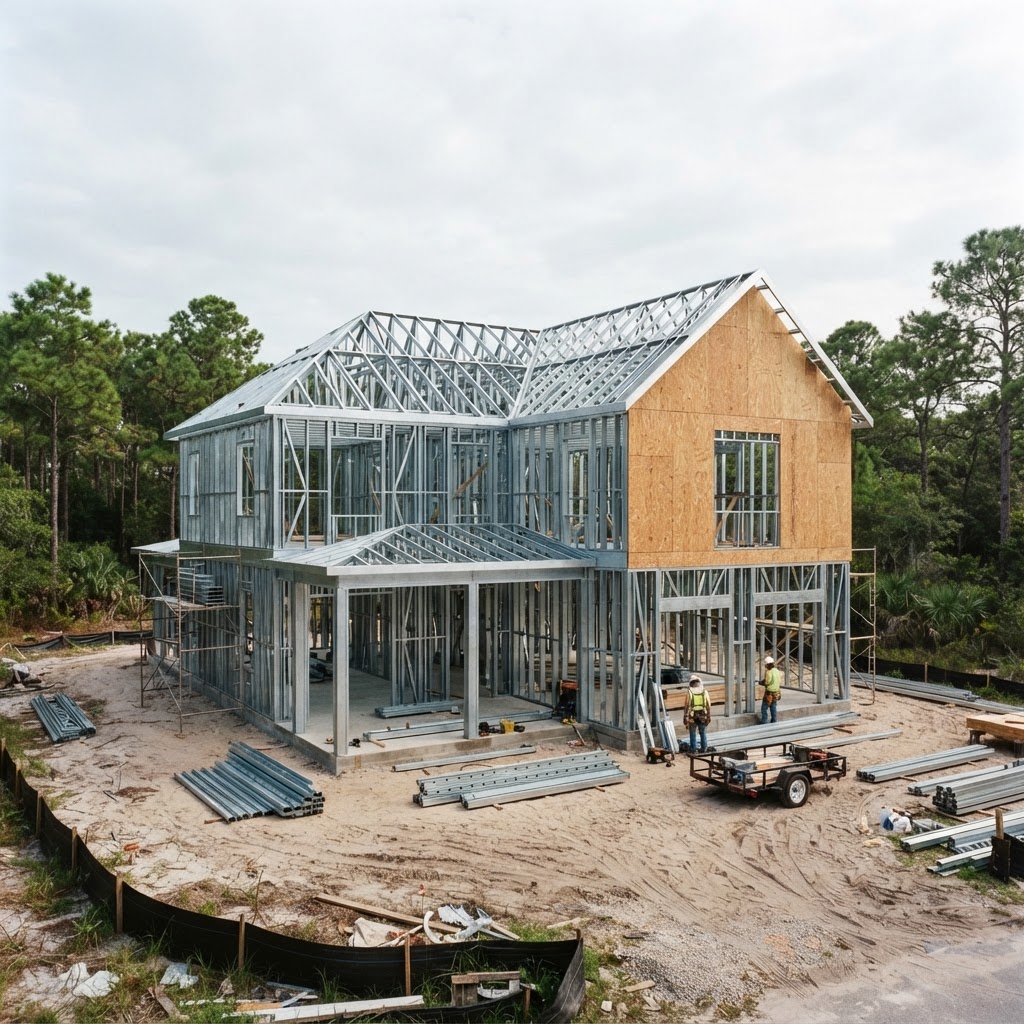
Light gauge steel framing is the same familiar skeleton as a wood frame — studs, joists and trusses — formed from cold-formed galvanized steel instead of lumber. It assembles the same way and finishes out the same inside the walls. The difference is in how the frame behaves over the life of the house.
To be clear about our history: every home we've completed to date was conventionally wood framed. Steel framing begins with our 2027 builds, and the framing package is supplied by ModuSteel USA.
 R
RWhat steel does
Four things steel gives you.
It stays straight.
Steel framing doesn't warp, twist, shrink, or settle.
Termites can't eat it.
The International Residential Code (R318.1) recognizes cold-formed steel as a method of termite protection. That protects the frame — it doesn't take the place of a termite bond on the rest of the structure.
It doesn't burn.
Steel framing is non-combustible.
It doesn't rot.
Steel framing does not rot.
What steel doesn't do
Claims we won't make.
Elsewhere you'll read that steel framing cuts homeowner insurance premiums, builds faster, or lowers the lifetime cost of a home. We don't make those claims, because we can't back them. We frame in steel because it stays straight, termites can't eat it, it's non-combustible, and it doesn't rot. That's the whole argument, and it's enough.
The build sequence
From lot to warranty registration.
- 01Lot and feasibility
- 02Plan selection
- 03Engineering and stamped plans
- 04Permit
- 05Foundation
- 06Frame
- 07Dry-in
- 08Mechanicals
- 09Finishes
- 10Final inspection
- 11Walkthrough
- 12Closing and warranty registration
Every plan we build is engineered and stamped by a licensed engineer before anything goes to the county.